
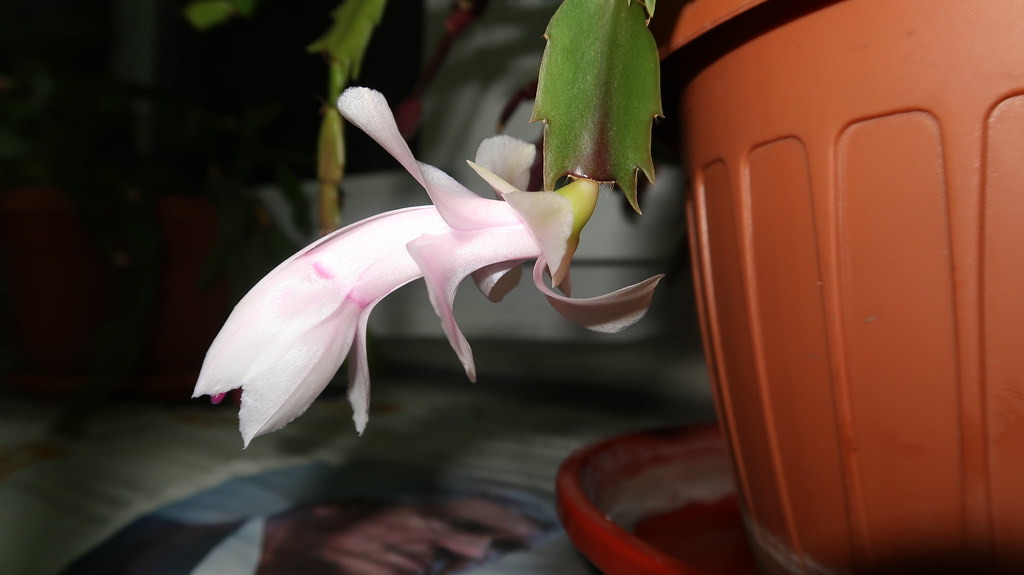
A Christmas cactus that won’t bloom is almost always getting too much light at night or too much warmth. Give it at least 12, and ideally 14 or more, hours of uninterrupted darkness every night, in a cool room that never climbs above 70°F. Start in early October, and keep the soil evenly moist once buds appear.
It’s one of the few houseplants that asks you to do less. Less lamp light, less warmth, less fussing. Here’s how to set up the long nights, and a countdown calendar from early October to December blooms.
Why won’t my Christmas cactus bloom?
Christmas cactus sets flower buds in response to long nights and cool temperatures. That’s how it knows the season has turned. Anything that interrupts those cues can hold it back:
- Light at night. A reading lamp, a TV, even light spilling in from a hallway can break the dark period. UF/IFAS advises keeping the plant away from artificial light at night from October through December if you want holiday blooms.
- A warm room. Iowa State’s Yard and Garden team notes that temperatures above 70°F prevent flowering even with short days.
- Moving it once buds form. The same guide recommends not moving a budded plant until the first flowers begin to open.
- Dry soil during budding. Dryness can cause buds or flowers to drop, according to Iowa State.
How many hours of darkness does a Christmas cactus need?
The numbers vary a little by source, because cultivars vary:
| Source | Nightly darkness | Temperature note |
|---|---|---|
| UF/IFAS | At least 12 hours | Blooms as days shorten and nights cool |
| Iowa State | 14 to 16 hours uninterrupted; some cultivars respond to 12 | 60 to 70°F ideal; above 70°F prevents flowering |
| Cornell | At least 12 hours | Around 60°F; ideal bloom temperature 50 to 55°F |
| UGA Extension | At least 14 hours of continuous darkness | Bring inside if temperatures go below 50°F |
Our studio rule, drawn from those: aim for 14 hours of true dark, in the coolest bright room you have, and never let it sit above 70°F. In practice, 14 hours means dark from about 6 pm to 8 am. An unused guest room, a cool spare room or a closet for the night all work, as long as the plant gets its daytime light back each morning.
The countdown: early October to December blooms
Cornell suggests starting 8 to 10 weeks before Christmas, in late September or October. UGA Extension says the long nights should continue for about 6 weeks to complete bud set. Here’s how that plays out if you begin in the first week of October:
| When | What to do |
|---|---|
| First week of October | Start the long nights: 14 hours of dark, every night, in a cool room. Bright indirect light by day. |
| Mid to late October | Keep going. Water when the potting mix begins to dry out, but don’t let it get too dry between waterings (UF/IFAS). |
| Early to mid-November | Look for tiny buds at the tips of the stem segments. Once you see them, keep the soil evenly moist. |
| Mid-November onward | Leave it where it is. Iowa State advises not moving the plant until the first flowers open. |
| December | Enjoy the blooms. Keep the plant away from heat vents, fireplaces, cold drafts and leaky doors, which Cornell lists as bud-drop triggers. |
Just brought your plants in from the porch? Our guide to when to bring houseplants inside covers the move. A holiday cactus coming indoors can go straight into its long-night routine once it’s settled.
Where should a Christmas cactus sit during the day?
In bright, indirect light. The long dark is for the night only; by day the plant goes back to its window. Skip the sill that bakes in afternoon sun: Cornell lists south-facing windows that heat up from the sun among the spots that cause bud drop. If you’re not sure what your windows give you, see our guide to reading the light by window direction.
What if it still won’t bloom?
Walk the room at 9 pm. Is there a lamp, a screen, a streetlight or a hallway glow reaching the plant? That’s the most common culprit. Then check the temperature where the plant actually sits, not the thermostat. Windowsills above radiators can run far warmer than the room. Fix those two things and give it another round of long nights. And if buds formed but fell off, look for a change: a move, a draft, a dry spell. UF/IFAS notes that Christmas cactus can be prone to bud drop, so avoid extreme environmental changes.
FAQ
Is Christmas cactus safe for cats and dogs?
Yes. The ASPCA lists Christmas cactus (Schlumbergera bridgesii) as non-toxic to dogs, cats and horses.
Can I just leave my Christmas cactus in a dark closet?
Only at night. Move it into the closet in the evening and back to bright, indirect light in the morning. The plant still needs daylight to grow and flower.
How long does it take to bloom after I start the dark treatment?
Plan on roughly 6 weeks for buds to set, per UGA Extension, and then flowers. That’s why Cornell suggests starting 8 to 10 weeks before you want blooms.
Why is my Christmas cactus blooming in November instead?
It may be a Thanksgiving cactus, a close relative. Iowa State notes that Thanksgiving cactus blooms from mid-November to late December, while true Christmas cactus runs from late November into early February. Check the stem segments: pointed teeth on the edges mean Thanksgiving; smooth, scalloped edges mean Christmas.