
There’s a particular look that small apartments full of plants tend to drift toward, and it isn’t always a flattering one. Twelve identical white plastic nursery pots, all sitting in a row on a windowsill, every plant the same height. It looks less like styling and more like inventory.
Styling plants in a small apartment is its own quiet discipline. Here’s the field guide we use in the studio.
Start with light, not aesthetics
The most beautifully styled plant arrangement falls apart in three months if the plants are in the wrong light. Before you think about pot color or shelf placement, identify your apartment’s three light zones:
- Bright direct. Within two feet of a south or west window. Few hours of direct sun daily.
- Bright indirect. Within six feet of any window. No direct sun touching the leaves.
- Low light. More than six feet from a window, or any north-facing room.
Match plants to zones first. Then style.
For the low-light corners, we have a full guide to the best low-light indoor plants.
Group in odd numbers
This is the oldest rule in any visual styling discipline, and it works on plants too. Arrangements of three, five, or seven plants feel intentional. Pairs feel symmetrical and slightly stiff. Single specimens feel lonely unless the specimen is large and architectural.
A grouping of three plants:
- One tall, structural plant (snake plant, dracaena, fiddle leaf fig)
- One mid-height, fuller plant (philodendron, peace lily, pothos in a bushy form)
- One trailing or low plant (string of pearls, baby pothos, small fern)
That trio works on almost any side table or shelf section.
Vary the height — including the planter
A small apartment usually means horizontal space is scarce. Use vertical layering: floor plant, side table, shelf, hanging planter. Even within a single grouping, the planter heights should vary. A tall ceramic pot, a low terracotta saucer, a hanging planter — different vessel heights create rhythm.
Tip: don’t just put plants on tables. Put plants on books, on stacks of books, on small wooden boxes. A $7 pothos in a $4 thrifted ceramic mug on top of a stack of three art books looks better than a $40 plant in a $30 planter on an empty surface.
The case against the matching planter set
You know the set. Six identical white planters in graduating sizes. Or six identical terracotta pots. They feel “designed.”
They aren’t.
Matching pots flatten a plant collection. The eye reads it as a single object instead of a small ecosystem. Variation — in pot material, color, shape, and especially in pot age — is what makes a styled collection feel collected, lived-in, and quietly expensive.
What we like instead:
- Terracotta (cheap, ages beautifully)
- Glazed ceramic in muted earth tones (moss green, terracotta, bone, charcoal)
- Vintage glass jars (for water propagation)
- Wooden boxes (cache pots, hide the nursery pot inside)
- Woven baskets (for floor plants)
Mix all of them. The collection will look like the slow accumulation of a real person, not a same-day Amazon haul.
Trailing plants are the small-apartment secret
If you have one shelf and limited floor space, trailing plants are how you create vertical interest without giving up horizontal real estate. A pothos cascading down a bookshelf reads as both decor and a small green canopy.
Trailing plants for small apartments:
- Pothos (golden, marble queen, neon)
- Heartleaf philodendron
- String of hearts (Ceropegia)
- Hoya (multiple varieties)
- English ivy (avoid if you have curious cats)
Hang one above eye level near a window and the room reads dramatically larger.
A single architectural plant is worth ten small ones
This is the most underrated styling principle. One large, architectural plant in a small apartment does more work than ten small ones.
A six-foot fiddle leaf fig in a corner. A mature monstera with a moss pole. A bird of paradise next to the window. These plants act as living architecture — they define a corner, frame a chair, soften a hard edge of a sofa.
Buy the largest version of one statement plant your budget allows, and put it where the eye lands first when someone walks in.
The repot bench: a styled object in itself
Most small apartments don’t have a dedicated potting bench. The repotting setup gets pulled together every few months on the kitchen counter or balcony. That’s fine — but the tools you store between uses are also part of how the space looks.
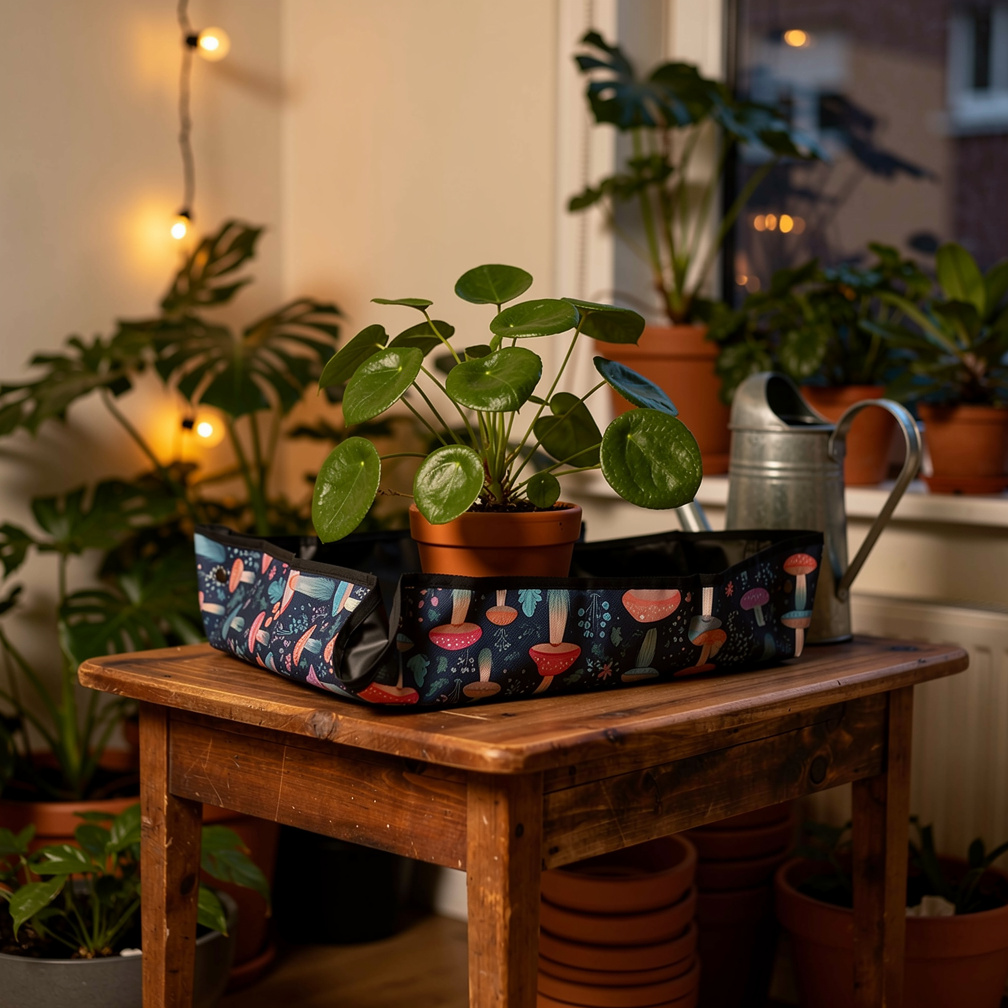
A rolled-up hand-illustrated potting mat, tucked behind a plant on a shelf. A small ceramic crock holding pruning shears and a chopstick. A glass jar of perlite. These quietly become decor.
We wrote a longer field note on the case for beautiful plant tools — short version: the tools you use shape how you feel about doing the work.
A few specific styling ideas for small apartments
The kitchen herb corner. Three small terracotta pots of basil, rosemary, and mint on the windowsill above the sink. Pair with a wooden cutting board leaned against the wall.
The reading chair plant. A single mid-sized floor plant (parlor palm, snake plant, peace lily) next to your favorite chair. The plant becomes part of the sit-and-read ritual.
The bookshelf canopy. A trailing pothos on the top shelf, with a few short, structural plants on the shelves below. Books and plants alternating.
The bathroom fern. Bird’s nest fern or a small Boston fern on a stool next to the bath. Steam and indirect light, perfect.
The bedside. One small plant on each nightstand — small enough that they don’t crowd a lamp. Pothos or pilea peperomioides are good candidates.
Final thoughts
Styling plants in a small apartment is really styling with plants. The plants aren’t accessories to the room; the room is built around the plants. Your apartment will end up looking less like a furniture catalog and more like a small living place that happens to also be a quiet greenhouse — which is, we’d argue, the better outcome.
Field notes published every other Sunday. The full collection is in the Journal.